This feature article was published in the April/May 2020 issue of Inside Track. You can read the whole issue at this link.
Fun With Fins
Rick Froehlich hits the Madras strip with a little help from his friends
By Steve Heeb
It has been more than five years since Rick Froehlich first got nudged into drag racing.
The driver from Redmond, Ore., says he stopped running his local autobody repair shop in 2007 due to multiple sclerosis, though it finally gave him a chance to play with his own cars.
Rick remembers as a 14-year-old borrowing 200 bucks from his father to buy his first car – a white ’57 Chevy 2-door Post.
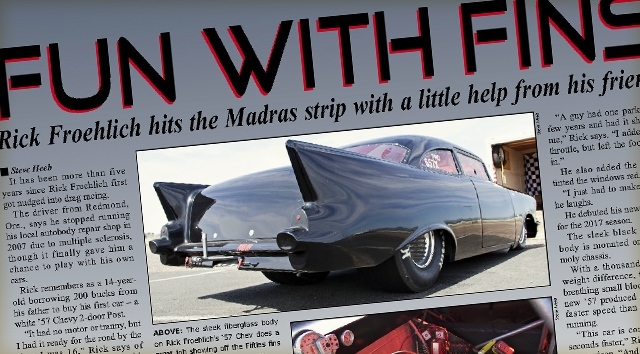
“It had no motor or tranny, but I had it ready for the road by the time I was 16,” Rick says of starting his passion for the mid-Fifties Chevrolets, with an affinity for the ‘57. “I just love the fins and the grill.”
All told, Rick has had several of these classics as street rods.
“My buddy Bill Ledford said I should give drag racing a try,” Rick recalls. “I finally brought my ’57 out to an Oldies event in 2014.”
Bill, who had been racing since he was 15, first met Rick in the Redmond 4 Bangers Jeep club. The extreme wheeling and rock crawling activities were quite different than the car show circuit.
“Rick always had hot rods for the car shows, but mine were for drag racing.” Bill laughs. “I told him it was like a car show, but once an hour you get to run it really hard.”
Friend Cliff Dwy, living within miles of the dragstrip in Madras, also encouraged Rick to take up racing.
Cliff recalls meeting Rick at a Cruz-in and offering advice to Rick about the carburetor on his ’57 Chevy.
“I knew he had a few nice cars and we started chatting,” Cliff says. “He wanted to know how to make his blower happy.”
“Bill and Cliff both have a tremendous amount of knowledge,” Rick says of the veteran racers.
Encouragement from Bill and Cliff finally convinced Rick to give it a try at the final nostalgia race in 2014.
“He brought his street car and has been hooked ever since,” Cliff laughs, recalling the days he first got hooked on racing as a 16-year-old catching rides to the dragstrip in 1968.
“That winter Rick bought a black ’55 Chevy from Doug Gray,” Bill says. “It was a street car just like the one in American Graffiti.”
The full-bodied, full-framed ’55 is powered by a 468-cid big block running on regular fuel. It uses ladder bars, even at a heavy 3,000 pounds.
“I thought maybe I could do this after all,” Rick said of getting his first taste of drag racing. “I was terrible, but I couldn’t believe I hadn’t started 30 years ago.”
“Rick made a great transition,” Cliff says. “He took his ’55 and really made it into a drag car.”
By the end of his first real season, Rick had won a race in his ’55, claimed Rookie of the year honors and was ranked fourth in the Sportsman points for 2015.
“I had no idea bracket racing was so in-depth,” Rick recalls of the early challenges, including his reduced muscle control from the MS. “I had to worry about syncing my legs.”
Rick’s second season caught up with him.
“I started overthinking,” he explains. “I knew I had to get a transbrake and hand throttle. I could have added them to my ’55, but I’m really a ’57 guy.”
An internet search provided just what he needed.
“A guy had one parked for a few years and had it shipped to me,” Rick says. “I added a hand throttle, but left the foot throttle in.”
He also added the grill and tinted the windows red.
“I just had to make it mine,” he laughs.
He debuted his new ’57 “Brutus” in Pro for the 2017 season.
The sleek black fiberglass body is mounted on a chrome moly chassis.
With a thousand pounds in weight difference, the alcohol-breathing small block 377 in the new ’57 produced considerably faster speed than the ’55 was running.
“This car is consistently 1.5 seconds faster,” Rick says of the comparison. “And it is fun.”
A Powerglide tranny shoves power to the Fab9 rear end and out to the 32x14x15 Hoosiers in back.
Cliff’s mechanical expertise was called upon to help fine tune the new car.
“We really figured out how to make it work for him,” Cliff says of the new Chevy. “He asked me to test the new car to see if it would go straight.”
Cliff has been with Madras Dragstrip since 1986, and had a hand in building many of the cars and engine that race there.
“Cliff and Bill have both helped me dial in the car,” Rick says. “This car is so fast now.”
Rick says he is always learning, and especially improved his reaction times.
“He’s better on the lights for sure,” Bill adds. “With the new car Rick has been spot on. The transbrake in the car has made a world of difference.”
Having good folks helping also has made a difference.
“I have to thank my wife Jodi and her daughter Cori,” Rick says of his family support. “I couldn’t do this without them.
Rick also credits Trevor Osbon for helping out each week.
By late 2019, Rick had determined that Brutus was becoming more of a challenge.
“Brutus had a chopped top and a funny car cage,” Rick explains. “It was just getting to hard to get in and out of the car because of my legs.”
The struggle was sapping some of the appeal of competing.
“I’m not done racing yet, so the answer to the problem is a new car,” Rick says of building another black ’57 Chevy: Dirty Harry. “It will be even faster with this new 632 big block Chevy.”
Watch for the new car to make its debut when the Madras Dragstrip opens back up.
“I just come up here to have fun,” Rick says of making the 30-minute haul from Redmond to Madras. “It’s close to home so I save some money.”
“He doesn’t miss a race,” Cliff says, even though the physical challenge might stall someone less determined than Rick.
Rick’s philosophy: “You should try anything if there’s even a chance you can do it.”
]]>
This feature article was published in the April/May 2020 issue of Inside Track. You can read the whole issue at this link.
Legend on the Rise
Kaiden Anderson makes tracks in Quarter midgets, Legends and Pro Late Models
By Steve Heeb
Kaiden Anderson faced his toughest competition younger than most.
The driver out of Yakima, Wash., was diagnosed with Stage 2 Neuroblastoma when he was two months old and battled that until he was 2.
“I’ve been all clear since 2003,” Kaiden says. “One side effect was no sports, but racing fits right in.”
He had great support from his father, Ron Anderson Jr., who had fielded the 37 cars in Yakima’s Street Stock and Bomber divisions.
“I started when I was 8 and ran Quarter midgets for six years,” he says. “We raced all around the Northwest.”
Kaiden started Quarter midgets powered by a Honda GX120 engine in Junior Honda, followed by a GX160in the Light 160s.
In his third year, Kaiden jumped to the Light World Formula division, with a more powerful Briggs & Stratton engine.
“In my first race I advanced from the B-Main to start seventh in the A-Main,” Kaiden recalls. “The car became a rocket and I won by half a track. Since then I knew I wanted to race.”
During those six seasons in Quarter midgets, Kaiden notched multiple regional victories. He racked up 11 championships and placed second and third at national events.
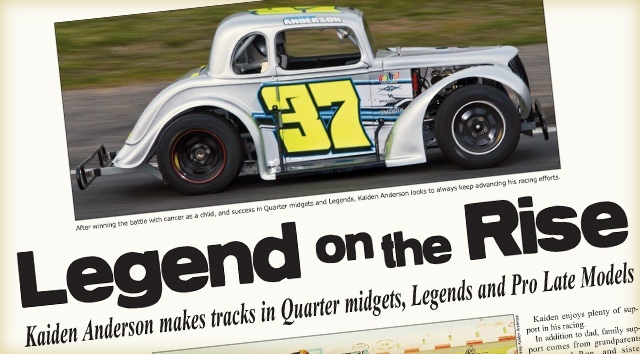
At 15, Kaiden began racing a Legends car in the Young Lions division.
“The biggest difference between the Quarter midgets and Legends cars is the speed and handling,” he reflects. “Quarter midgets are easier to handle and they have no clutch. I had to get used to the clutch in the Legends and focus on steering.”
He says his dad was a huge help in transitioning to the faster racers and bigger tracks.
“He taught me stuff like driving lines and pick up points on the throttle,” Kaiden says.
Kaiden also credits Chance Overholt at Kustom Fab in Richland, Wash.
“He is my mentor,” Kaiden says. “ He sets the cars up and shows me how to do it. Without him I couldn’t do this.”
He says Chance offered him the best advice early on.
“I had been using the clutch on my starts,” Kaiden explains. “Chance showed me to just lift off the gas and shift to keep momentum at the start.”
Kaiden also learned from competing with long-time veterans like Randy Schaaf, who has multiple state championships since starting in the Legends in 2000.
“Randy is quick everywhere,” Kaiden laughs. “He’s been in Legends as long as I’ve been alive.”
“I race for these young guys,” Randy says. “I like to be a mentor for them.”
“Beating Randy would be quite an accomplishment,” Kaiden said of his goals at the time.
All the advice paid off as Kaiden won the Young Lions championship that year and made a trip south to Las Vegas for a national qualifying event.
“There were 30 cars there and they were all quick,” he laughs. “It was my first year and it was really exciting.”
There certainly was no Sophomore slump for Kaiden, who certainly made the most of his second season in the Legends.
Kaiden snagged the (2017) Semi Pro championship for Washington state, finished fourth in the Race of Champions at Nationals, and ended with an 8th-place finish in the National Championship race.
He also placed third in the National Traveling Series, having competed at 10 different tracks throughout the Northwest including Wenatchee, Puyallup/Graham, Monroe, Elma, Yakima, Portland, Hermiston and Meridian.
Kaiden recalls some extra excitement during the 2016 Fourth of July weekend at Meridian.
“They shot off fireworks in the parking lot and they were landing on our cars in the pits,” he laughs.
Kaiden’s travel time was trimmed the following year, only competing in eight races, on the podium for each with three wins, four runner-ups and a third place.
Kaiden enjoys plenty of support in his racing.
In addition to dad, family support comes from grandparents Carrie and Ron, and sister Mykala.
Jerod Marin tackles crew duty for Kaiden.
“Jerod has been a great crew guy and has helped me tremendously,” Kaiden says.
Kaiden thanks Chance at Kustom Fab and Dave Winchell, who helps with tires on the Legend.
He adds that Jim Schimmel was a great help while they were competing in Las Vegas.
Kaiden maintains a good friendship with Caity Miller and Justin McClure.
“Caity races out of Meridian, Idaho and they have become great friends of mine,” he says. “They even came and helped out during my first Pro Late Model race.”
Kaiden knew he was ready to jump into full-size race car when he accomplished one of his big goals for the Legends, finally beating Randy in an exciting race at Meridian in 2018.
“At that moment right there. I knew I had accomplished a lot in racing,” Kaiden says. “Beating one of the very best to race Legends.”
Last season, Kaiden focused on fielding a Pro Late Model in three races.
“I was super fast at the Fall Classic,” he says of Yakima Speedway’s prestigious late-season event. “I was in the top 5 out of 38 cars with less than 10 laps to go, but ran out of fuel with one lap left.”
If the season ever gets underway, Kaiden hopes to get 10 races in 2020.
“First on my list is Apple Cup and I cannot wait,” he says of the chance to return to Yakima Speedway. “We have tested a couple times and I feel like we have a winning car.”
Here’s hoping Kaiden, and all the Northwest drivers, have a chance to hit their favorite tracks again as soon as possible.
]]>
This feature article was published in the June/July 2018 issue of Inside Track.
Man of Many Mopars
By Steve Heeb
Almost 40 years ago, Kelly Thomas went with his father to look at cars and picked up a ’65 Dodge Dart.
“That car smoked the right rear no matter what,” Kelly says of that six-cylinder four-speed.
At the time he was 16 and turning wrenches in auto shop at Montlake Terrace High School.
“Kelly was just looking for an open road,” shop teacher Skip Carlson recalls. “He was a super kid with a real love of cars.”
Skip also remembers the teachers going on strike and Kelly taking full advantage of the opportunity.
“The strike gave Kelly a chance to drive his car up and down in front of the school,” Skip explains.
Perhaps a little too much.
“I got caught street racing by a State Trooper,” he explains. “He gave me directions to the dragstrip and checked in on me for the next couple years.”
That bit of guidance put Kelly on the right track for good.
“Once I was here I never left,” he says.
He started fielding a ’69 Dodge Dart Swinger in the Heavy bracket at Pacific Raceways – then Seattle Int’l Raceway. He recalls being influenced by the Bertoldi brothers.
“John and Alan were the track champions back then,” Kelly says.
In 1989, Kelly turned laps in the Pro bracket with a ’67 Barracuda and notched two track titles in a four-year span.
He sold the Barracuda in 1993 and hit the track in a ’91 Jeep Commanche pickup that he raced from 1994 to 2001, when he opened Kelly’s Auto Repair in Auburn.
Within a couple years another race truck found its way into Kelly’s Mopar stable.
“I found a ’94 Dodge Ram factory Mopar race truck in Louisiana,” he says. “I had it shipped up here on the back of a flatbed semi.”
The new pickup helped him pick up Divisional wins at Boise in 2008 and again in Seattle in 2012, as well as numerous top-qualifier postings along the way.
Around 2007, Kelly bought a ’73 Plymouth Duster to race in Stock Eliminator.
In 2013, he swapped out the original 340-cid and converted the car for Super Stock division.
“I put in a different 340 Super Stock legal motor,” he says. “Also a lightweight transmission and aluminum driveshaft.”
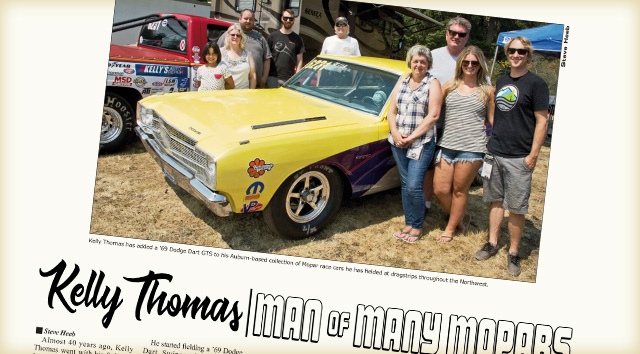
He added another Super Stock Dodge to the mix, this one a ’69 Dart GTS.
“It’s just a creampuff,” he says. “It drives perfect and works well.”
Under the hood beats a’73 340-cid motor with Edelbrock aluminum cylinder heads; factory carb and compression; and a T&D valve train.
Even with limited passes in the car by the NHRA Northwest Nationals at Pacific Raceways, Kelly was making 10.43-second runs at 126 mph.
“It’s my favorite,” Kelly says of the yellow Dart GTS. “But the truck is still part of the family.”
Kelly gets plenty of family support from wife Dawn, daughters Jessica and Pam and their husbands Brent and Kyle, respectively.
“I have to thank all the crew at Kelly’s Auto Repair, past and present,” he says. “Manager James Davis and the rest of the crew keep the shop running flawlessly while I am out doing this.”
He also is grateful for all the people who have helped throughout the years.
From the long-time auto shop teacher and good friend Skip Carlson, to Jim Storms, Brian Engelking, Brad Van Lant, Dale Green and Pat Blais.
“I have a lot more good people around me,” he says of the personal friendships he’s developed through racing.
He’s also enjoyed a partnership with Mopar that has helped him race throughout the NHRA Division 6 venues and beyond, from north of the border at Medicine Hat Dragstrip in Alberta, Canada, and south to Pomona, Calif., and Top Gun Dragstrip in Fallon, Nev.
He appreciates all the support along the way and recognizes how things have changed for him.
“I used to mix my own fuel,” he recalls of his early efforts. “Now I order VP by the drum.”
On race day he might bring three of the 12 Mopars he owns.
“They are all great cars,” he says of his collection. “They stick with you for life.”
Beyond the machines, Kelly also recognizes the hard work needed to stay competitive in close brackets.
“I look up to any of the Stock and Super Stock Division champions,” he says, with advice for those new to the sport. “Just stay after it and don’t give up.”
Four decades after having curbed his street racing, Kelly enjoys the straight and narrow of the dragstrip.
“It’s a good clean fun sport,” he laughs. “Come on out and have a good time.”
]]>
This feature article was published in the June/July 2018 issue of Inside Track.
Zoomin’ Boomer
By Steve Heeb
Growing up, Joe Bowers was no stranger to the race track. His father John raced Hardtops and his brother raced at Klamath Speedway as well.
“Jack was a big influence,” Joe says of helping on his brother’s Hobby Stock car. “I knew I had to get my own car.”
In 1976, Joe was ready to field his own’64 GTO convertible that he ran in Hobby Stocks for a season.
The next year he ran Street Stocks with a ’69 GTO.
“I would put the big tires on it to run with the Supers,” he says of always trying to expand his racing resume.
For several seasons Joe kept busy behind the wheel and trying to raise funds.
“I was still learning but I wanted to be a pro,” he says. “I had to have money and experience.”
Then a brand new series caught his attention: The Nascar Northwest Tour.
Joe ran full-time during the Northwest Tour’s inaugural 1985 season, competing in 14 of the 15 races on a schedule that included venues in Oregon, Wahington, Nevada, Idaho and California.
He finished in the top 10, in a field made up of the region’s top drivers including Derrike Cope, Dirk Stephens, Chad Little, Ron Eaton, Bob and Leon Fox, Rick Shultz and the series’ very first champion, Garrett Evans.
After a quick breather, Joe was back at Klamath Speedway to earn the Sportsman title in 1988.
“They used to have a $500 bounty for anyone who could beat him,” Debbie laughs. “They even ran an ad in the Nickel paper.”
Joe says that when the season ended, he was given the unclaimed bounty.
He followed up with a second consecutive title in 1989 and earned the track’s Most Popular Driver recognition.
In 1990, Joe put in another full-time effort with the Northwest Tour, including a top-5 finish at South Sound Speedway in which he led 88 laps.
He continued to travel the West Coast from 1991 to 1995 racing in Late Models, Open Comp and Sportsman events in Oregon, Washington, Nevada and California.
In 1994, Joe and wife Debbie decided to have some fun with the No. 1 car while raising some money for their racing efforts in the NorCal series.
“We wanted to involve the kids so for $5 they could sign a vinyl hand and we’d put it on the car,” Joe explains. “The car was orange and blue with white hands plastered all over it.”
“They looked like butterflies all over the car,” Debbie laughs.
Joe credits Dick Mauro, car owner and sponsor, for matching the money from the hands promo and other sponsorships received.
With the car being No. 1, he also says it was natural to have foam finger hands for the fans in the stands.
Joe and Debbie also produced a newsletter that they sent out to keep their junior fans up on Joe’s racing successes.
Their efforts paid off as Joe won the NorCal Series championship that year.
In 1996, Joe put aside his racing suit to start his own business building street rods as Bowers Race and Rod Shop.
Almost a decade would pass before the next generation of Bowers were ready to race. Joe’s three sons – Nicholas, Will and Clint – shared seat time in a Mini Stock they built for the 2002 season at Douglas County Speedway.
Joe was back on the track the following year when the family got a second car and alternated which pair would drive each week.
The following year Joe and Clint each ran one of the cars full time, and Joe picked up the 2004 Mini Stocks title, and successfully defended his title in 2005 with father-son finishing 1-2 in the season points.
After that, the family put Clint in a Modified for a season at Roseburg, but soon other priorities pushed racing onto the back burner.
However, so many experiences were centered on racing that they couldn’t shake it.
“Our family spent so much time together on the road,” Debbie reflects on their racing adventures. “They still like to road trip, and we all have to travel together when we go. We even scheduled our family reunion at South Sound Speedway.”
In 2015, Joe began racing with the NW Pro4 Alliance Late Model series with Clint by his side as crew chief and spotter.
“I wanted to apply what we had done before,” he says of the path that got them to this point.
A path that weaved its way throughout the Northwest, including tracks in Coos Bay, Eugene, Lebanon, Roseburg, Spanaway, Monroe, Wenatchee, Yakima, Tri-Cities, Tenino, Post Falls, Meridian and the dirt in Medford. California tracks like Bakersfield, Yreka, Madera and Ukiah. Down to Phoenix and even racing for fun in Charlotte.
“My favorite times have been racing at Douglas County with my kids,” Joe reflects. “Racing with my boys was fun.”
With Joe back on the road following the NW Pro4 Alliance schedule, Debbie helped focus his racing efforts.
“He was the car builder and the driver and the crew chief,” she explains. “Now he’s just the driver. It’s what he likes the most.”
For this season, Joe and Debbie had a new car built by Chuck LaHorgue, a veteran fabricator with more than 200 cars built over the past 35 years.
“We just happened to be at the same race last year,” Chuck says of meeting Joe by chance, and taking the order for a new Late Model.
Chuck’s own Super Late Model efforts date back to 1986 and include the 2001 title at Shasta Speedway.
“I also ran some Modifieds on the asphalt,” Chuck says. “But after the championship I quit driving full-time.”
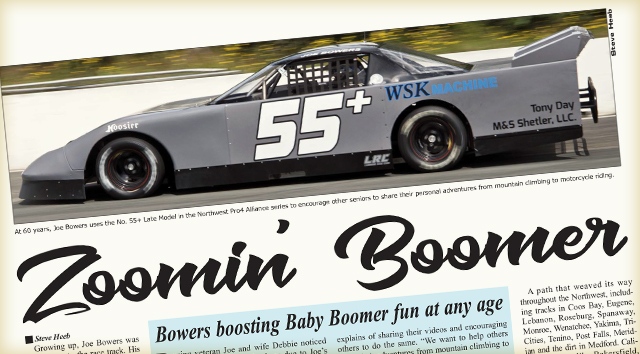
Joe and Debbie field the new car as the 55+, promoting their “Baby Boomers at Play” program. They share their current adventures with the NW Pro4 Alliance and encourage other seniors to do the same with their exciting activities.
For the younger set, Joe’s advice for drivers starting out is to work hard at marketing and not be bashful.
“We had to go out and get sponsors,” he explains. “Early on we tried racing hard, but we didn’t pursue the dollars we needed. We could have been more productive in the sponsor hunt.”
Four decades later, there were plenty helping out.
“Our customers became our friends and some became sponsors,” Joe says. “Like Tony Day. He liked the racing so we put his name on the car.”
Joe credits WSK Machine for all the engine work they’ve done over the past 25 years, but thanks Looper’s Auto Rebuilding owner Dale Looper for building the 2.4-liter Duratec engine in his new car.
“Dale is a great asset to the team,” Joe says. “He’s been helping me for two years now, with his machine work, engine work, crewing and engine tuning at the track.”
Chuck is also at the track helping Joe on race day.
“The car he built is awesome and he’s been doing a great job setting it up and tuning it at each race so far this year,” Joe says. “He is on the crew as long as he wants to be.”
More support comes from M&S Shelter, who assist with a workshop for the car, and Stayton Tire & Auto.
“They do all my tires,” Joe says. “They’ve really helped me out all the way back to my Mini Stock days.”
Joe also offers a shout-out to Craig Neves.
“Craig is a great guy, pit crew and spotter at the track,” Joe says. “He’s an ambitious, hard working, fun guy.”
Joe also recalls competing with Craig’s dad Steve.
And Joe is grateful for the unfaltering family support.
“Debbie has been there since the beginning,” Joe says of his wife. “She’s always working hard, sacrificing, supporting and pushing to improve every step of the way.”
Encouragement from Debbie and the boys has helped keep Joe hitting the track at age 60.
“I just wish we could have done this when I was 30,” Joe sighs. “But we couldn’t do this at this level until now.”
He and Debbie are trying to squeeze all they can out of this opportunity.
“We’re not done yet,” he laughs. “We race for fun, but the winner has the most fun. That’s who we want to be.”
Bowers boosting Baby Boomer fun at any age
Racing veteran Joe and wife Debbie noticed they were growing a fan base due to Joe’s age and wanted to tie the brand new NW Pro4 Alliance car in with a project they were developing.
“Fans found out how old I am and I got a following of people my age,” Joe laughs. “We opened a lot of eyes.”
“He’s 60 and plans on racing 15 more years,” Debbie adds. “And he’s still competitive.”
They decided the team would help promote activities with their “Baby Boomers at Play” program
The car number was switched from 13 to a distinctive 55+ and they installed a GoPro camera to shoot videos of Joe in action.
“We want to engage people over 55,” Debbie explains of sharing their videos and encouraging others to do the same. “We want to help others share their adventures from mountain climbing to motorcycle riding.”
Their grandson Joshua, 9, has been tasked with handling the 55+ team’s online presence.
“It’s just great to see grandpa racing,” Joshua says.
With Joshua’s help, the Bowers maintain an online presence with the babyboomersatplay.org website and the babyboomersatplay accounts established on facebook and Instagram.
Joshua’s own racing includes Junior Karts and Mini Sprints, but he hopes to be a race car driver and designer when he is a few years older.
Perhaps grandpa Joe will still be out there giving him a run for the money.
]]>
This feature article was published in the June 2017 issue of Inside Track.
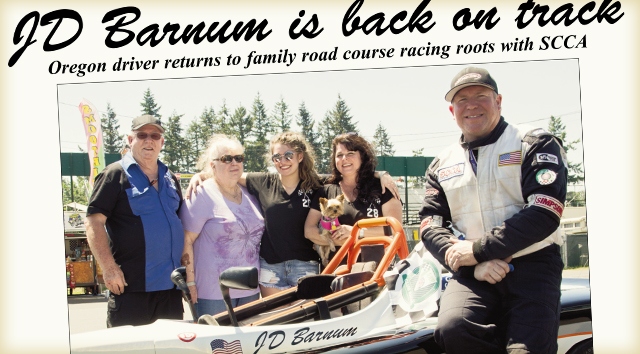
JD Barnum is Back on Track
Oregon driver returns to family road course racing roots with SCCA
By Steve Heeb
JD Barnum was up on two wheels at the age of 5, riding a motorcyle for fun and watching his father John race, whose long-time SCCA membership dates back to the 1960s.
“Dad dabbled in Autocrossing early on, but also raced motocross and enduro as well as road racing shifter karts,” JD says.
JD’s own passion for racing was fueled by experiences at the race track.
“My family and I spent our spring and summers watching guys like Frank Pool race Trans Am cars,” JD says of the Northwest veteran who would later play a role in JD’s racing efforts. “It set the foundation for my future – I knew I had to find a way to race, and I would race anything!”
That opportunity came riding a MR50 at Mulky Park in McMinnville, Ore.
“I raced BMX and Motocross for six or seven years until injuries pushed me into karts,” he says.
John eventually left the SCCA in order to travel to kart races with his son.
“Dad and I started racing karts in 1992 from Canada to California and spending many many hours practicing at Pat’s Acres Karting Complex where we used to have a key to practice any time we wanted.”
The dedication paid off and JD saw much success as the Novice Heavy champion for the Portland Kart Assoc. in 1995, and earned a pair of titles the following year in IKF Region 6 (representing Washington, Oregon and Idaho) for both the 80cc Road Race and 80 cc Sprint Kart divisions.
He moved to shifter karts and competed in northern California, posting second in the SKUSA points in 2000 and earning the NorCal title in 2002.
In 2003, JD made his last race in a 125-cc shifter kart, and the Barnums set their sights on building a car to run on the dirt track at Lebanon.
That plan changed when the family ventured north to South Sound Speedway to watch a race on the paved oval.
“We decided to keep the car an asphalt Late-model, which could run in the Limited Late Model class or as a Super Stock,” JD says. “I loved the atmosphere there. They put on a great show.”
A year later, JD was putting on a good show too, driving his No. 2 Pontiac Grand Prix to a podium finish in his very first race there, even while getting used to a whole new type of racing.
JD’s kart had sported a 40-hp motor for a 400-pound machine, vastly different than the 550-hp motor bolted into the 3,200-pound Late Model he was fielding in the 2004 season.
“The karts were much faster,” he laughs.
And the differences were apparent off the track as well.
“The cars were so much work,” he explains. “We had to work on the car after each race. We really tore everything up.”
“We replaced a lot of metal and fiberglass for each race,” John says of repairs to his son’s Pontiac. “We had to make sure the car was looking good.”
JD credits great advice from former Trans Am racer and Nascar chief engineer Frank Pool.
“He really helped us with the Late Model,” JD says of the veteran he used to watch race. “He always has been big on our racing. It’s nice to hear from a guy with that kind of experience.”
Eventually the toll of weekly repairs caught up with the Barnum team in 2006.
“My first race at South Sound I had finished third and my last race I came in on fire,” he laughs. “We figured that was it.”
With the Pontiac done for, and a new child at home, JD took a break from racing for the next five seasons.
Seeking a form of racing more suited to the young family, JD turned to the SCCA that had been good for his father.
“Dad started as a Starter but spent most of his years as a Steward helping keep the races organized,” JD says of his father’s involvement on and off the track. “He was the Regional Executive for the Oregon Region SCCA in 1984 and was one of many that help bring the CART cars to Portland for the 1984 Stroh’s 200.”
“I worked with CART and the safety crews, coordinating with the SCCA and Rose Festival,” John says of bringing the elite racing circuit to Portland Int’l Raceway. “We had 150 workers at the actual event coordinating with CART and IMSA and Trans Am. That was an intense six months of effort by a whole lot of people.”
It was great experiences like that which helped JD return to the family roots in road course racing.
“It just has more of a family atmosphere and that is what racing is to us,” JD says.
He picked up a used 1994-vintage Spec Racer Ford with a Gen 2 motor setup.
“I knew the SRF was competitive and could be run on a budget,” he says. “This is a race car that is very cost effective.”
In addition to being based on a very reliable chassis setup, JD notes that SRF is meant to be a driver’s class.
“We all have the same parts,” he explains. “Most of the races come down to only thousandths of a second apart.”
“This car is different,” John says comparing the SRF with the Pontiac they had fielded at South Sound Speedway. “Maintenance is low with the SRF. The Late Model was more work to repair damage and the SRF is more time on maintenance and set up.”
Working with the car set up, the Barnums were back in touch with Frank Pool.
“We still work with him,” JD says gratefully. “We call to get his thoughts on set-up ideas.”
Trading the ovals for road courses also meant a shift in driving philosophy.
“Instead of charging hard into the corners, now I look to carry speed through and out of the turns,” JD says. “There was a lot of contact in Late Models. In SRF the competition is extremely tight because the cars are so equal.”
The SCCA racing has brought him back to some of the Northwest road courses he had grown up with.
“Portland is convenient and I like the level of competition there,” he says. “And I like Pacific Raceways for nostalgic reasons.”
Though he and his dad take care of the car themselves, JD appreciates what Flat Out Racing has done for the group of racers scattered throughout the Northwest.
“They maintain virtually all the cars in the Portland area,” he explains, citing their extensive inventory. “They help keep the group strong by carrying parts so a guy like me can afford to go racing.”
He also thanks Mikki Rice for helping keep the family’s uniforms looking sharp.
On race weekends, JD’s pit area is populated by parents John and JoAnn, wife Rusti and their 16-year-old daughter Jaden, who comes to all of dad’s races.
“I am very thankful that my wife supports our racing and is very involved because it takes everyone to make it happen,” JD emphasizes. “Yes, my dad and I do most of the work during the week, but come the weekend we have a large crew of family and friends that make it all happen and as a group we have fun.
JD’s sister Jennifer Colby and brother-in-law Mike are at most events to help out, as is father-in-law Russ France.
And this group never goes hungry at the track.
“We all eat good,” JD says. “JoAnn is really good at cooking Italian food.”
“She’s good at everything,” Jennifer laughs.
The family’s racing efforts paid off in 2016 as JD had the kind of season many racers dream of.
He set three track records at Portland Int’l Raceway, won the SCCA Majors event there and picked up the Rose Cup championship. He also notched the Oregon Region champion as well as the NorPac title, representing the western states Alaska, Washington, Oregon, Idaho, California and Montana.
So, what does a defending Gen 2 champion do over the off season?
Swap out the engine and jump classes, of course.
“We’ve updated it with a brand new Gen 3 engine package and replaced everything in it,” he said during the SCCA event at Pacific Raceways in May. “But with the SRF we are always making forward progress. With the Late Model we were always working just to get the car back to the track.”
]]>
This feature article was published in the June 2017 issue of Inside Track.
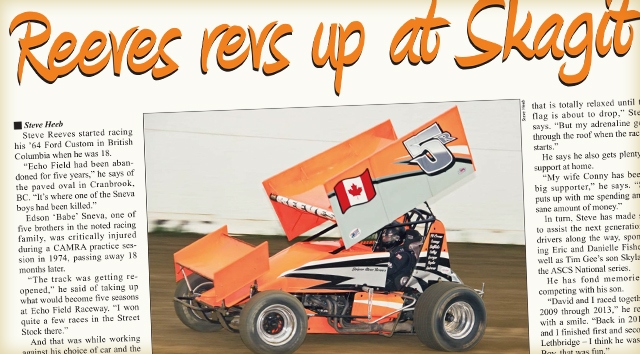
Reeves revs up at Skagit
By Steve Heeb
Steve Reeves started racing his ‘64 Ford Custom in British Columbia when he was 18.
“Echo Field had been abandoned for five years,” he says of the paved oval in Cranbrook, BC. “It’s where one of the Sneva boys had been killed.”
Edson ‘Babe’ Sneva, one of five brothers in the noted racing family, was critically injured during a CAMRA practice session in 1974, passing away 18 months later.
“The track was getting re-opened,” he said of taking up what would become five seasons at Echo Field Raceway. “I won quite a few races in the Street Stock there.”
And that was while working against his choice of car and the availability of performance parts on a budget.
“Don’t even try to race a Ford,” he laughs. “It’s too expensive to make them go fast.”
A family move and work commitments led to a break from racing that lasted 25 years.
“Then my oldest son David started racing stock cars in 2006,” he explains.“It didn’t take long before I was back at the track with my own car.”
In the following years he raced on the pavement at Hythe Motor Speedway in Alberta and in the dirt at Tayor Speedway in British Columbia.
“My friend Bill Lanktree raced sprint cars and had been bugging me to try one,” Steve recalls. “My son tried it and bought one. I tried it and never went back – it’s four times the rush.”
So at the age of 50, Steve bought his first sprint car from veteran World of Outlaws driver Tim Gee.
“Tim helped me a lot,” Steve says of the assistance from Gee and Gee Racing. “Without him I never would have got the hang of it.”
He admits the experience on the pavement circuits had been much easier than the switch to driving his No. 78 Sportsman Sprint at dirt tracks like Skagit Speedway.
“You have to forget everything you learned in stock cars,” he says of the finesse needed in a sprint car. “You can’t let them hit you and you can’t hit anybody. You have to break all your old habits because they work against you.”
He says a driver can’t lift while racing a sprint car.
“As soon as you get off the throttle the car goes in the other direction,” he adds.
However, the open wheel cars prove to be more accessible than their full-fendered counterparts.
“Sprint cars are ten times easier to work on than stock cars,” he says. “Bill Lanktree just had a small bag of tools – that was all he needed to get through a raceday.”
When he made the move to 360 Sprints division, Steve he purchased a complete car that happened to be bright orange.
“I finished last but after the race the kids all gathered around my car more than the winner,” he smiles. “So I’ve kept this color all the time.”
His current ASCS 360 Sprint is built on a chassis from ART Speed Equipment.
“I’ve raced XXX and Maxim,” Steve says of the different chassis. “The ART is stiffer.”
Steve appreciates help from Northwest veteran Marc Huson, whose Shark motor provides power for the 5n car – painted fluorescent orange of course.
Steve also thanks Skagit Speedway promoter Steve Beitler for allowing him to keep some of his racing equipment on site, rather than making a 13-hour haul from Valleyview, AB, to Alger, Wash., each week.
In addition to being fairly regular at Skagit, Steve also has seat time at Canadian tracks in Lethbridge and Edmonton, and US tracks in Montana and California, and has run the Speedweek events in Oregon.
“I like the track at Yakima too,” he says of State Fair Raceway. “It’s so fast.”
He does prefer a wetter track conditions at race time.
“I was always good on the sticky ones,” he smiles. “Stomp and steer is easy. Slick tracks require more finesse.”
He points out that he has been working to improve on that.
“I’m getting better at the slick tracks like Skagit gets to be by the end of the night,” he says.
Crew chief Steve ‘Buffalo’ Scribner and the crew – George and Cathy Noordegraaf, wife Conny and brother Andrew – all ensure the car is prepared to make it through the race, helping take pressure off of Steve.
“Actually, I am one of those rare guys that is totally relaxed until the flag is about to drop,” Steve says. “But my adrenaline goes through the roof when the racing starts.”
He says he also gets plenty of support at home.
“My wife Conny has been a big supporter,” he says. “She puts up with me spending an insane amount of money.”
In turn, Steve has made sure to assist the next generation of drivers along the way, sponsoring Eric and Danielle Fisher as well as Tim Gee’s son Skylar on the ASCS National series.
He has fond memories of competing with his own son.
“David and I raced together in 2009 through 2013,” he recalls with a smile. “Back in 2010 he and I finished first and second at Lethbridge – I think he was first. Boy, that was fun.”
He has a message to those looking to take up sprint car racing.
“Start out young because this is hard when you’re old,” he chuckles, having taken dirt track racing up when he was 50. “You’ve got to drive against some 14-year-old that doesn’t own a bolt in their car and has already been racing 10 years. They have no fear!”
]]>
This feature article was published in the June 2017 issue of Inside Track.
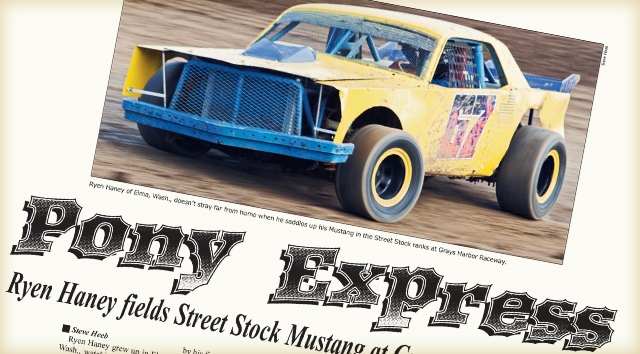
Pony Express
Ryen Haney fields Street Stock Mustang at Grays Harbor Raceway
By Steve Heeb
Ryen Haney grew up in Elma, Wash., watching his father Chip race Street Stocks at the hometown dirt track, Grays Harbor Raceway.
In 2000, they bought a ‘67 Mustang they planned to get racing.
“We got it half built before we gave up and took up riding quads,” Ryen recalls.
When the family needed to move, the project was again on the front burner.
“We had to finish the car,” he explains. “Just to get it out of the garage.”
A 383-cid Windsor was bolted in and Ryen was able to log five races in 2009, followed by his first full season in 2010.
“I was the Hobby Stock rookie of the year that season,” he says of the 2010 campaign at Grays Harbor Raceway. “The class is now the Street Stocks. It’s become more standardized with other tracks.”
He also hauled south to Coos Bay Speedway to improve his racing.
“I went down there to learn patience,” he explains. “And work on not pissing people off.”
He admits he made it tougher on himself than needed.
“It’s been a long lesson,” he reflects. “I ignored everything dad said back then.”
With more seasons under his belt, Ryen has seen the improvements.
“I used to be totally out of control,” he laughs. “Now I am a lot smoother.”
Ryen also has kept an eye on other talented drivers at the track, especially Jack Parshall Jr.
“He’s so smooth and never over-drives his car,” Ryen says of the veteran. “He’s always fast, but doesn’t try to take more than the car will give.”
In addition to Grays Harbor Raceway and Coos Bay Speedway, Ryen has competed at Skagit Speedway and Sunset Speedway.
“Coos Bay is the most fun, but Grays Harbor will always be home,” he says.
He also notes he hasn’t had a chance to test the dirt at Willamette Speedway and Cottage Grove Speedway.
He is grateful for unshakable support from parents Chip and Gloria, though he recalls an incident that put his mom to the test.
“Dad and I broke down while on our way to the Dunes,” he says of a spring road trip that happened to be on April First. “I called my mom but she didn’t believe me.”
Eventually she was convinced and came to their rescue.
He ranks his late sister Shella Graham as his biggest supporters up until her recent death in May.
Outside the family, Ryen lists several sponsors that have helped his racing efforts, including Tracey’s Racing Jewelry, D&D Dyno, Ewing Racing Engines and Finish Line Graphics.
Ryen still drives the same Mustang in the Street Stocks at Grays Harbor Raceway, now powered by the third motor since he started.
“I’m still getting everything figured out,” he says. “I’m back in it full time so I have to re-teach myself some things.”
He’s still working on being smooth and patient, and following the advice he received long ago.
“Hold your line – the fast guys will go by you,” he counsels new drivers. “Trying to get out of their way is what causes problems.”
And his solution: “I try to run up front as much as I can.”
]]>
This feature article was published in the May 2017 issue of Inside Track.
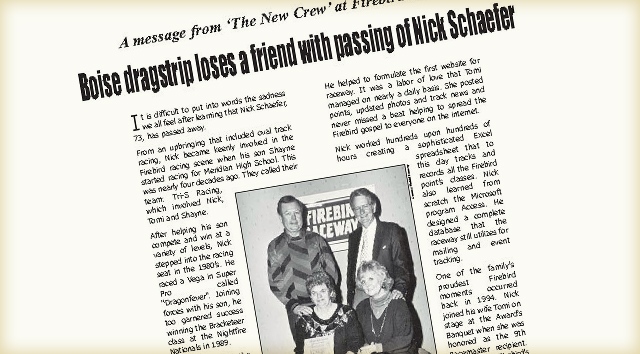
Boise dragstrip loses a friend with passing of Nick Schaefer
From Firebird Raceway
It is difficult to put into words the sadness we all feel after learning that Nick Schaefer, 73, has passed away.
From an upbringing that included oval track racing, Nick became keenly involved in the Firebird racing scene when his son Shayne started racing for Meridian High School. This was nearly four decades ago. They called their team: Tri-S Racing, which involved Nick, Tomi and Shayne.
After helping his son compete and win at a variety of levels, Nick stepped into the racing seat in the 1980’s. He raced a Vega in Super Pro called “Dragonfever”. Joining forces with his son, he too garnered success winning the Bracketeer class at the Nightfire Nationals in 1989.
He did so much for the Firebird racing scene, it would be hard to put it all into words. Annually both he and his wonderful wife Tomi helped in a variety of areas. They put together everything from decorations at the Banquet to building displays for Firebird racers at the annual Roadster Show. Every year they would build a pit scene at the Classic that was second to none. They supported the Team Finals and the Gem State Series on multiple occasions.
The duo was wholeheartedly behind the track securing a Jaws of Life rescue tool. They worked hard to raise the funding to procure the Hurst tool and generator. This apparatus is still a key part of the Firebird Safety Team. Most noteworthy, Nick was not only a savvy machinist and race car fabricator, but also near genius when it came to creating applications for computers.
He helped to formulate the first website for the raceway. It was a labor of love that Tomi managed on nearly a daily basis. She posted points, updated photos and track news and never missed a beat helping to spread the Firebird gospel to everyone on the internet.
Nick worked hundreds upon hundreds of hours creating a sophisticated Excel spreadsheet that to this day tracks and records all the Firebird point’s classes. Nick also learned from scratch the Microsoft program Access. He designed a complete database that the raceway still utilizes for mailing and event tracking.
One of the family’s proudest Firebird moments occurred back in 1994. Nick joined his wife Tomi on stage at the Award’s Banquet when she was honored as the 9th Racemaster recipient. The award is Firebird’s equivalent to being inducted into a Hall of Fame. It was a very special moment in Idaho racing history.
There are many, many things that Nick played a role in. Many elements he first created are still in place today. He was someone who never sought to be in the limelight. Nick was genuine, caring, smart and keenly interested in helping Firebird become a better place to race. He constantly enjoyed letting his work and contributions do the talking.
We will forever be indebted to everything he did for the raceway. Every member of the New family, staff and racing community are deeply saddened by the loss of an icon of Drag Racing in Idaho.
]]>
This feature article was published in the May 2017 issue of Inside Track.
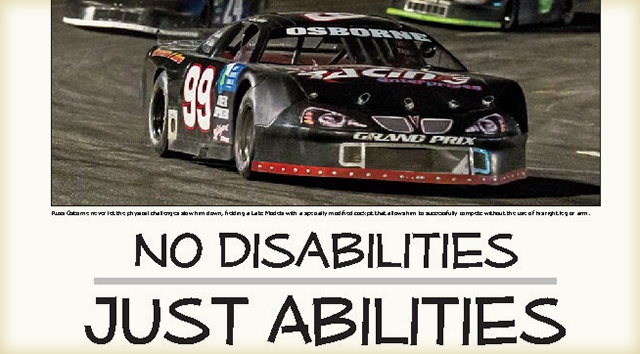
No Disabilities – Just Abilities
By Rod Jeffers
February 27, 1964: Russ Osborne was born the fifth son in a large family. The boys were all athletic and competitive, so by the time he was seven years old Russ was playing hockey and baseball. Within two years, he was on the advanced teams for both sports.
On February 17, 1980, while playing on a Midget A hockey team (representing the greater Spokane area), he was slammed into the boards and his helmet failed when his head hit a metal standard. His jaw was shattered; he suffered multiple skull fractures as well as collarbone and shoulder injuries.
A tracheostomy tube was inserted and remained in place for over 100 days and over the next weeks and months, he underwent a number of surgeries to relieve pressure on his brain and repair as many injuries as possible.
He was in and out of a coma for four months, during which time doctors told his family that if Russ came out of the coma, he very well could be in a vegetative state for the rest of his life. There was little to no chance of his ever walking again.
Russ very quickly proved the experts wrong, and managed to catch up with is high school classmates and graduated on time. At that point, his greatest ambition was to get out of his wheelchair and walk across the stage to accept his diploma … and he did!
At 17 he started driving a truck with a standard shift. After graduation, he joined a gym and worked out every day. He never lost his drive to compete even though he could no longer play hockey, baseball or football.
In 1987 he contacted local race car driver/instructor Bruce Garber and asked how hard it would be for him to race. Bruce agreed to help him and after a short demonstration Bruce set him in the driver seat.
Since the left side of his brain had stopped functioning, his right hand and leg are paralyzed. But that hasn’t kept him from competing and winning, having learned to make the best use of his left arm and leg.
Once his crew settles him into the driver’s seat of his highly modified cockpit, and with the help of a high powered automatic shifter on his left side, he takes control and powers around the track with the best of them.
Russ had a son in 1987 and a daughter in 1991. He then took the next 11 years off from racing to raise her as a single parent.
He returned to the track in 2006. Because he has never lost his competitive desires and continues to actively pursue his dream, his record is enviable:
n He ran in the NASCAR sanctioned ICAR series for seven years. In each of those seven years he placed in the top-10 for his class of 25 cars.
n Once the ICAR series folded, he began racing at Stateline Speedway, where he placed in the top-10 every year. His best outcome was third place overall.
n In 2015 he ran in two series: one at Stateline and the other at Spokane County Raceway. He finished fifth overall at Stateline and third at SCR.
n In 2016 he was driving two NASCAR-type Pontiacs. He is set to team up with Dave Garber, son of his original mentor, Bruce Garber. Their hope is to represent the Special Olympics with the support of generous donors and sponsors.
Russ lives independently and personally funds the Russ Osborne Memorial hockey trophy which is given annually to the most outstanding hockey player in the midget division. He is a strong Christian who has survived and lives by the grace of God. On the back bumper of each car he drives is that statement “Have faith in God”.
Russ lives by the motto “No Disabilities–Just Abilities” which is printed on the side windows of each of his cars. He is always willing to meet his fans, never fails to take the time to autograph photos or talk to children who are thrilled to meet a real race car driver. He even at times allows them the joy of sitting in the driver’s seat of the race car.
]]>
This feature article was published in the Midseason 2016 issue of Inside Track.
White Lightning
Scotty B White storms into SCCA Majors competition
By Steve Heeb
By the time Scotty B White was 15 he had sailed to a championship while racing catamaran sailboats in a one design boat class for Dingo’s. About the same time, he also was pounding the ground with his TM250 Suzuki and Honda Odessy ATVs on local trails with friends and at race tracks in Puyallup and Spanaway.
Northwest drag racing fans may recall the 454-powered ’73 Chevy Shortbed pickup that he fielded at Pacific Raceways and the Puyallup Dragstrip.
In 1994, Scotty started competing in autocross meets all over the country. Two years later he was participating in the open track days and training with veteran racer Cindi Lux.
“She was my first real road course instructor,” he says of learning from the champion driver from Aloha, Ore., who he would team up with a few years later.
“My first year was iffy,” Scotty says. “I started getting trophies in my second and third seasons of autocrossing.”
He took cues from autocross veterans like John Ames in Utah.
“He was ‘Mr. Cool’,” Scotty says. “Just the nicest, slickest driver. Such a great driver.”
He learned the importance of going slow to go fast, and that autocross is based primarily on precision and hitting the proper marks through the corners.
“There is a finite speed that a driver can go,” he explains, citing Formula I champion Michael Schumacher as an example. “He’s the best driver and maybe he can go 73 mph through a corner. If the maximum speed possible is 73, then trying to go faster will actually cost you way more time than going through at 68.”
He says drivers should run as close as possible to their own personal threshold.
“If a 1.3G-load is your maximum and you step over it you are going to lose control,” he says. “And you’ll never make up the time you lose for that mistake.”
He worked on being smoother and more deliberate as he raced the clock on the autocross course. Scotty joined more than 1,000 drivers in Topeka, Kan., for the SOLO championships from 1994 through 2006, winning Solo II and Pro Solo championships along the way.
But Scotty laughs that it was in 1997 that he turned his first wheel in anger in wheel-to-wheel competition. That’s the year he earned his Novice SCCA road race and Porsche club licenses and got a taste for the longer road courses at Pacific Raceways, Portland, the old Las Vegas track and Sonoma in his ’90 911 Carrera II with the stock seat, roll bars and a 5-point harness.
“There were all the same principles at 140 as there are at 70,” he says of the much faster speeds on the road course. “But if you get it wrong you risk writing off your car.”
He notes that those with autocross backgrounds usually make for good road racers.
“They are excellent planners, not just young and relying on reflex,” he says of the importance of being calm while racing. “A lot of drivers’ heart rates go crazy. I’m totally relaxed as long as I trust the other guys.”
He laughs that racing is the polar opposite to what is portrayed in the Fast & Furious movies.
“It’s like walking on a roof – you can’t go at it halfway, you have to stand up and commit to walk upright with confidence otherwise you’ll slide off,” he says. “Road course racing takes more money and balls than autocrossing. You have to be confident and brave. You have to commit fully.”
In 1998, he joined a few others committing to the SCCA’s brand new Touring 1 class for sports cars.
“This was for high-powered two seaters,” he says of fielding his C4 Corvette in T-1. “I was driving my 300-horsepower Corvette against 450-horsepower Vipers.”
The SCCA Runoffs class was small that year, with only 4-5 cars and he recalls suffering frequent mechanical problems trying to stay competitive against the stronger cars.
Success came the following year when Scotty notched his first pro win during the World Challenge at the 1999 Molson Indy race in Vancouver, BC, in his C5 Corvette which led to sponsorship from General Motors.
In 2003, Scotty and Cindi Lux teamed up to run their Corvettes for two seasons.
“We really challenged each other in a good way that made us both better drivers,” Cindi says of competing in the same classes. “I had a huge amount of respect for him when we raced against each other.”
In 2005, they signed on with Dodge to run a pair of Vipers in T1 competition.
“He and I had some great races where you couldn’t put a piece of paper between us,” Cindi says. “But the one who won always really deserved it that day.”
By the end of the 2007 season, Scotty had tested his mettle in Utah, Sacramento and San Diego.
In 2008, Scotty took a break from racing but still had an impact on his racing partner.
“I got the Mopar deal and Scotty took some time off, but he loaned me his transporter,” Cindi explains. “He was a true gentleman and very generous.”
Scotty took four seasons off from driving, to focus on business and launching his daughters into life getting through high school and into college.
When he resumed driving, Scotty was up to speed right away.
“I’ve always been good at the road courses,” he says. “When I ran the first Legends road race at Portland I was so much faster than the group. I was knocked off the track and fought back to the front three times.”
“He’s got a lot of passion and works very hard,” Cindi says of Scotty’s drive. “He’s a thinking race car driver. And he’s only gotten smarter.”
She says some race fans might look at Scotty’s size and assume he would drive harshly, when the opposite is more true.
“He has the finest touch,” she describes his racing finesse. “He’s really in tune with what the cars need and doesn’t abuse the car at all. I would race an enduro with him any time.”
Scotty bought his 2006 Viper back and now competes in GT-2, which he can weight down to also run T-1. His 2012 Mustang for T-2 can be weight-adjusted to also meet the T-3 limits, and he fields a 2007 Mustang in the T-4 ranks.
On the long 5-mile Thunderhill course, Scotty powered his Mustangs to track records in both the T-3 and T-4 classes.
“It was awesome – so much fun,” he beams.
He has plenty to thank for his fun: BF Goodrich, Hawk Performance, Knight Transport LLC, GipsonMotorworks and Team Extreme CMT.
“We’re proud to help with engine development for Scotty,” says GipsonMotorworks owner Mike Gipson. “I’ve known him more than 30 years. We went to Ohio together and laughed so much because we are essentially the same people. He’s really a good guy.”
Scotty and Motorsports USA partner Jerold Lowe also credit Syked ECU Tuning that helps tune their engines to peak performance.
“Using AIM data analyzed by Jerold Lowe of Motorsports USA has upped our game,” he says. “We can change a line just a bit and can see what happens with predictive lap times.”
Sometimes the biggest challenge can be prepping the car on a race day with changing weather.
“Steady rain is no problem – it’s on and off that’s the toughest,” he says of deciding between running dry tires or the wet package. “Rain tires still have to get warm, and even dry tires will grip a wet track if you get heat in them.”
More than just swapping the tires, the car’s suspension also is adjusted for wet track conditions.
“We adjust the alignment if we know it’s going to be wet,” he says of prepping the car to be looser. “We soften the car’s suspension, then use automatic dampeners to try and keep the car as stiff as possible.”
When the SCCA Majors took over Pacific Raceways for the Memorial Day weekend, there were both wet and dry sessions, but it didn’t seem to bother Scotty, who collected five wins and a runner-up competing in the T-3, T-4 and GT-2 classes. He also turned some laps in the T-1 and T-2 sessions to earn enough points to qualify for the SCCA Championship Runoffs in Ohio in September.
No one wants to see Scotty pull off a championship more than Cindi, who has watched him at several SCCA Championship runoffs along the way.
“He’s been so close at the runoffs so many times and in so many classes,” she says, keeping track of his progress more than a decade after they raced Corvettes and Vipers together. “We keep in touch and still help each other out with car set up.”
Like those who have helped guide his racing program to where it is now, Scotty works to help develop other drivers.
“We try to help a few new kids along when we can,” he says, citing Kyle Byers as an example of a new talent to watch.
Two other up-and-coming drivers are following in their dad’s footsteps.
“My daughter Hannah got her Novice license and is starting her own road racing career,” he smiles.
And you can bet he’s advised her: you need to go slow to go fast.
]]>